The More-Silver-Is-More Myth
Silver accents need not match to feel cohesive. Use contrast, varied finishes and clear space to make a collection look deliberate rather than crowded.
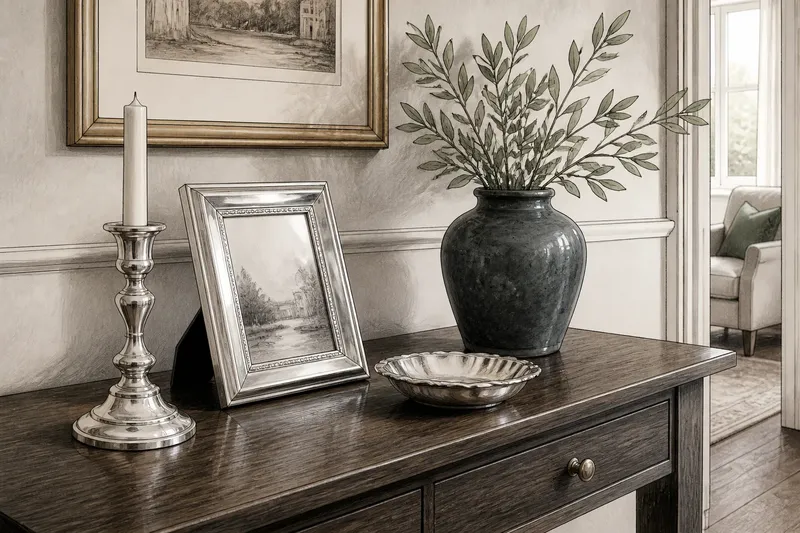
A polished silver frame, a bright candlestick and a small bowl can sit on the same mantel without forming a set. Silver accents often look more deliberate when their neighbours differ in shape, finish or material. The useful question is not how many silver objects belong together, but what each one contributes to the grouping.
Matching is not cohesion
Matching pieces make a clear statement: they belong together. That can be pleasing when a room calls for formality, or when a pair of candlesticks flanks a mirror. But extend that logic to every object on a surface and the arrangement can start to resemble a display counter.
Cohesion is looser. Objects can feel related because they share a line, a mood or a point of contrast. A narrow silver frame and a rounded pewter-coloured vessel, for instance, may suit each other through their quiet tones while keeping distinct silhouettes. They need not pretend to have arrived in the same box.
Look first for one connection, not several. It might be a repeated curve, a similar scale, or the way two pieces catch a small patch of daylight. If finish, shape, size and ornament all match, the grouping has little room to breathe. One shared quality is often enough to make the relationship legible.
Give each piece a role
Before arranging objects, decide which one should lead. A broad, low bowl might carry the visual weight; a slender candlestick might draw the eye upwards; a small frame might supply a sharper edge. The roles need not be announced. They simply prevent every object from asking for attention at once.
Supporting pieces can be quieter in scale or finish. A matte silver box beside a polished bowl offers a change in reflection without introducing a new colour. A dark ceramic object can make the silver easier to read, while a glass piece may echo its glint without copying its material.
Try moving one item away rather than adding another. If the remaining objects become clearer, that removed piece may have been repeating a role already filled. This is not a verdict on the object; it is a decision about the particular surface and arrangement.
Use contrast deliberately
Contrast gives a grouping its shape. Silver reflects its surroundings, so a nearby surface can alter its appearance: dark wood makes the edge seem crisp, while pale stone can soften it. A brushed finish behaves differently from a mirror-bright one, even when both are cool in tone.
Mixing finishes works best when the difference is easy to see. A softly aged vessel beside a highly polished frame creates a clear shift. Two nearly identical finishes can look like an unsuccessful attempt at matching, particularly when their slight difference seems accidental. If the distinction is subtle, give it support through another contrast, such as a change in silhouette.
Shape matters as much as shine. Pair a broad, rounded object with something narrow or angular, rather than lining up several similar outlines. The aim is not to make every piece oppositional. It is to let the eye move from one form to another without encountering a row of near-duplicates.
Colour can help, but it need not become a palette exercise. A single deep green book, a charcoal tile or a warm wooden edge may give silver a point of reference. Keep such companions in service of the objects, rather than adding accents simply to prove that the arrangement has been styled.
Leave useful space
Empty surface is part of an arrangement, not a problem waiting to be solved. A little clear space around a silver piece lets its outline remain visible and gives reflected light somewhere to settle. When objects touch or crowd one another, their shapes merge and the grouping loses its internal rhythm.
Start with enough room to place each item without overlap. Then bring the pieces closer only where a relationship becomes clearer. A frame may sit near a small vessel; a taller candlestick may stand apart so its height reads cleanly. The exact spacing depends on the surface, but each object should still be recognisable at a glance.
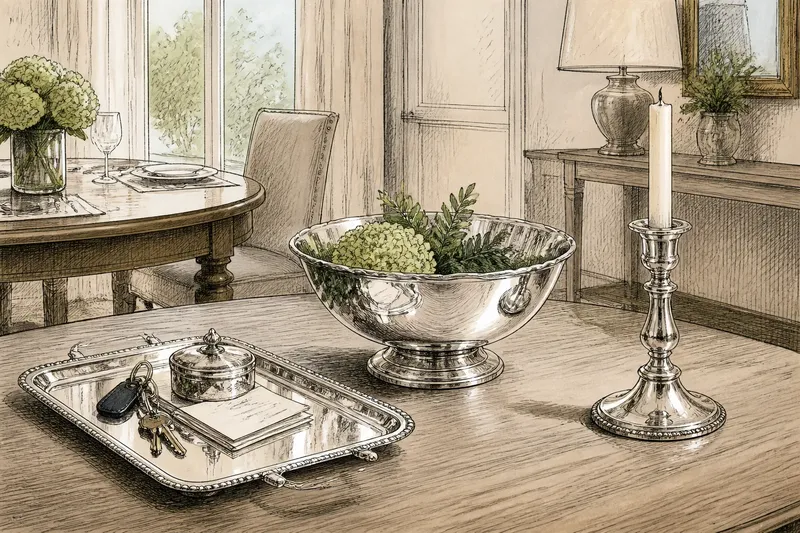
Leave practical room as well as visual room. On a dining table, avoid arranging silver where it obstructs serving dishes or makes conversation awkward. On a console, keep the area used for keys or post available if those are part of the household’s routine. An arrangement that cannot tolerate ordinary use is mostly a photograph with furniture nearby.
Read the grouping aloud?
How many silver pieces should sit together?
There is no useful fixed number. Stop when each piece has a distinct role and the surface still has clear space; add another only if it contributes a new shape, finish or function.
Can different silver finishes share a shelf?
Yes. A polished object and a brushed or gently aged one can make a considered pairing when their difference is apparent and their forms are not competing for the same role.
Should silver objects be arranged in pairs?
Pairs can give a mantel or sideboard a formal balance, especially when the objects flank a central feature. For a looser grouping, an uneven number may feel less staged, but the objects still need a clear relationship.
What can balance a silver accent?
Balance can come from a contrasting material, a different silhouette or a patch of empty space. A dark ceramic piece or a wooden object may supply enough visual weight without adding another silver item.
A quick arrangement edit
Imagine a narrow console with a polished silver frame, two matching candlesticks, a small silver dish and a dark ceramic vase. To loosen the set-like effect, keep one candlestick beside the frame, move the other to a different room, and place the vase at the opposite end. The expected result is a grouping with a repeated silver note, a contrasting form and a visible gap, rather than a row of matching metal.
Then look at the arrangement from the doorway and from the place where it is usually seen. If the frame disappears behind the vase, shift one object rather than adding height elsewhere. If the silver reads as a single bright patch, separate the pieces enough for their outlines to register.
Changing the arrangement is more useful than making a permanent rule about which objects belong together. A candlestick may suit the console on a quiet day, then move to a dining table when the surface has another purpose. Let the grouping respond to the room’s actual use, not an imagined obligation to display everything at once.
Keep the decision simple
When a silver grouping feels too coordinated, remove one repeated element or introduce a clear difference in shape or finish. When it feels scattered, identify one shared quality and bring the relevant objects into a more legible relationship. These small edits tend to be more effective than buying another matching piece.
The more-silver-is-more myth mistakes quantity for intention. A few distinct objects, chosen for how they relate and separated by useful breathing room, can make silver feel at home without turning a shelf into a showroom. If you are choosing silver accents, consider what each one adds before asking whether it matches.