A Rainy-Day Shelf Reset for Silver Pieces
A rainy-day shelf reset for silver pieces helps you edit one crowded shelf, settle a silver object in place and decide which existing items belong nearby.
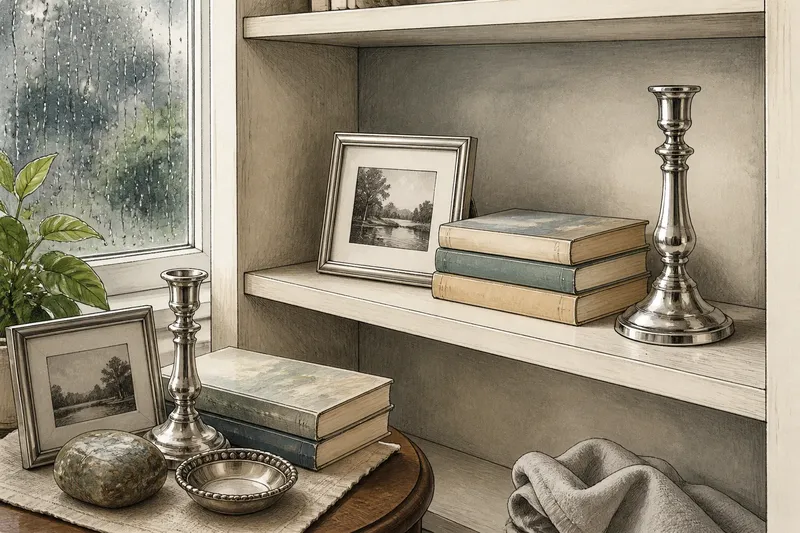
Rain taps the window beside a shelf holding a silver candlestick, a framed photograph, three paperbacks and a decorative stone. A rainy-day shelf reset for silver pieces starts by taking those objects down and deciding what the shelf needs to do, rather than building a miniature display around the candlestick.
Keep the removed items together on a nearby table. This is an edit of one shelf, not a household clear-out, and none of the objects needs to be polished or banished before you can see the space clearly.
Read the empty shelf
Remove everything, including post, coasters and objects that seem too ordinary to count. Set them on the holding table rather than sending them straight to a cupboard. Wipe the shelf with a suitable cloth and let it dry.
Handle silver with care, especially if it is plated, delicate or has a finish you do not recognise. This is not the moment for a polishing experiment. Arrange the pieces as they are, and consider their care separately.
Look at the bare shelf from the doorway and from the seat you use most. Notice what blocks the view, where the light falls and which objects need to remain reachable. A shelf beside a lamp, for instance, has a different job from one that holds books or keys.
Set a shelf purpose
Choose a simple purpose before returning anything: holding the books you reach for, displaying a photograph, or keeping a small everyday item to hand. The purpose sets a limit. Objects that interfere with it can stay on the holding table, even if they are attractive.
Return the silver piece only if it suits that purpose and fits the shelf safely. Check that it does not obscure a switch, make a nearby item awkward to reach or sit where it is likely to be knocked. Its place should make sense in the room, not merely in a photograph.
Which silver piece fits?
Should the silver object be the largest?
No. Choose the piece whose shape and scale work with this shelf. A small bowl may sit comfortably beside books, while a tall candlestick could make a narrow space feel crowded.
Can a useful object stay here?
Yes, if the shelf makes its use easier rather than harder. A bowl used for keys needs room to receive them without knocking into a frame or book stack.
What if two silver pieces compete?
Ask whether they serve distinct purposes on this shelf. If both demand space for the same job, keep the one that fits the shelf’s purpose and place the other elsewhere for now.
Does the silver need polishing first?
No. Decide on placement before deciding on care. For cleaning, use a method appropriate to the object and its finish, and follow the maker’s guidance where available.
Return only what helps
Bring items back one at a time, checking each against the shelf’s purpose. A book stack may belong if the books are used there; a photograph may belong if it has a clear place and remains visible. The decorative stone need not return simply because it was there before.
Check these details as you edit:
- Observe whether the silver blocks a switch or handle; if it does, move it away from the control, otherwise leave that access clear.
- Observe whether a book spine or title is hidden; if it is, shift the stack or leave the silver elsewhere, otherwise keep the books within easy reach.
- Observe whether the photograph can be seen from the usual seat; if it cannot, reposition the frame or remove it from this shelf, otherwise let it stay.
- Observe whether the shelf’s everyday item has room to be used; if it does not, remove a companion object, otherwise keep the useful item accessible.
- Observe whether any object rocks, leans or sits precariously; if it does, move it to a safer surface, otherwise leave it in place.
- Observe whether an item has a clear job on this shelf; if it does not, return it to the holding table and find it another home, otherwise keep it.
Say the shelf contains a silver candlestick, a photograph, three paperbacks and a decorative stone. You decide the shelf’s purpose is to hold books and the photograph. You stack the paperbacks flat, place the frame where it remains visible, and set the candlestick beside them only after checking that it does not crowd the frame or sit in the way of book access. The stone has no role in that arrangement, so it stays on the holding table. The resulting choice is clear: keep the books and photograph here, retain the candlestick only if it fits without obstructing them, and find another place for the stone.
Check the shelf in use
Step back to the doorway, then look from the seat or standing place you use most. Check whether the shelf purpose still reads clearly and whether anything is hidden, hard to reach or in the way. If one item causes a problem, remove or reposition that item before disturbing the rest.
Try the shelf as you normally would. Reach for a book, use the bowl if it belongs there, or operate the nearby lamp. If the arrangement makes an ordinary action awkward, it is not finished. A decorative object can wait; the light switch cannot.
If the shelf looks bare, leave it for a while before adding anything. When you return, add an item only if it serves the shelf’s purpose or solves a specific practical need. An empty patch is not evidence that something is missing.
Where do removed objects go?
Keep the removed objects on the holding table until you have decided where each belongs. Some may return to another shelf, a desk or a drawer. Others can remain out of sight until you have a reason to use them again.
Finish when the silver has a safe, clear place and the shelf still does its ordinary job. A rainy-day shelf reset for silver pieces does not require a perfect display; it asks only that each object earn its place in this particular corner. Before putting the holding table away, check that the items left off the shelf have somewhere sensible to go.