Placing Silver Around the Home Without Making It a Display
Silver at home can sit comfortably in working rooms, not just on display. Choose a spot that suits its use, the room’s routines and its condition.
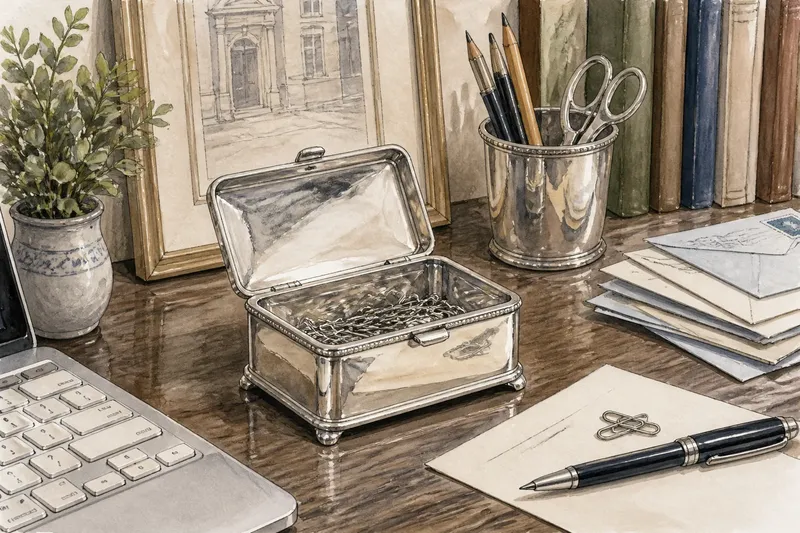
A silver-plated box on a desk can hold the paper clips that otherwise migrate under the keyboard. Silver at home need not be reserved for the dining room or arranged as a miniature still life; its placement can follow the ordinary traffic of a household.
Silver at home
Begin with the room’s routine, not the object’s history. Notice where you pause, set things down or reach for a small tool. A silver object can belong there if its size and condition suit the task and it does not interrupt the work already happening.
This is different from choosing a focal point for a shelf or building a coordinated display. The question is where a piece can live among the routes and surfaces people already use: by the front door, beside a reading chair, on a dressing table or near a desk.
Everyday routes
Think of a room as a set of repeated movements. In an entrance, keys and post arrive; beside a chair, spectacles and a bookmark may be put down; at a desk, clips and stamps need somewhere to go. Match the object to one of those existing habits rather than inventing a new one for its sake.
Check the surface, too. A narrow console may be crossed by bags and parcels, while a bedside table needs space for a lamp, water and whatever is used at night. If a silver piece would be knocked, block access or make a task awkward, choose another location. A pleasing spot is not useful if everyone has to negotiate around it.
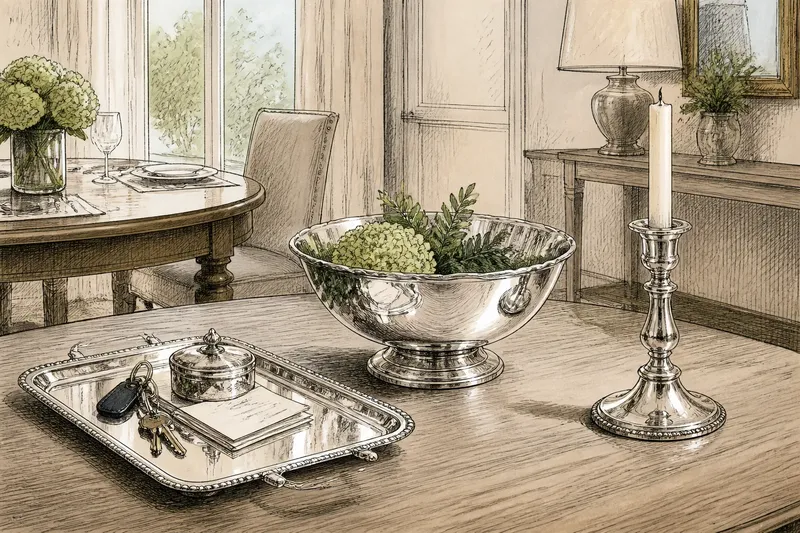
Say you have an inherited silver-plated dish, a hall console that collects post, and a habit of dropping loose keys near the door. Put the dish at the console’s clear edge and use it for those keys. If post then lands in the dish or the keys obstruct the console’s other use, move it to a desk drawer or leave it as a display object elsewhere. The point is to judge the placement by what actually happens in that corner, not by what the dish seems to demand.
Use or display
Some pieces are better left decorative. A candlestick with a loose socket, a box with a sharp damaged edge or an object of uncertain material may not be suitable for active use. Keep it out of the task until its condition and intended use are clear; for food-contact questions, consult the maker’s guidance or a qualified specialist.
For sound, suitable pieces, favour a job that fits their form. A small bowl can receive rings on a dressing table; a sturdy tray can corral spectacles on a side table. If using an object feels wrong, display is a valid choice. Place it where it will not obstruct work, rather than turning every family possession into a household tool.
Room by room
- Hall: If a small dish can sit clear of the door swing and the main landing area, use it for keys; if it crowds the console, move it to a desk or keep it decorative.
- Desk: If a lidded box opens without displacing the keyboard or papers, use it for clips or stamps; if its lid catches or it interrupts writing, move it to a drawer or another surface.
- Bedside: If a small bowl leaves room for the lamp and items needed at night, use it for rings; if it narrows access to those essentials, place it on a dressing table instead.
- Reading chair: If a tray remains stable beside the chair and does not block the route through the room, use it for spectacles; if it wobbles or narrows the walkway, choose a firmer side table.
- Dining area: If tableware is clean, sound and suited to food contact, use it at meals; if its condition or material is uncertain, keep it for display and seek reliable guidance before serving food in it.
- Bathroom: If a silver-plated container can be kept dry and away from regular splashes, use it for dry items such as cotton buds; if moisture reaches it, move it to a drier room or use a material better suited to the setting.
Placement questions?
Does silver have to stay in a formal room?
No. Choose a room according to the object’s practical role, condition and the household’s routine. A useful place may be a desk or hall, provided the piece does not obstruct the task.
How can I tell if a spot is too busy?
Notice whether the object blocks a drawer, narrows a route or gets moved each time the surface is used. If any of those happens, relocate it or choose a less intrusive use.
What if I prefer not to use the piece?
Keep it as a decorative object in a stable spot where it can be seen without taking over a working surface. Display does not need to involve a formal arrangement or a special occasion.
Changing places
Household routines change. A bowl that works on a hall console may become inconvenient when the console takes on another job; a box may be more useful near a desk during a period of letter-writing. Reconsider the location when you notice repeated clearing, accidental knocks or an object sitting untouched because its supposed role no longer fits.
Keep the decision small: name the task, check the object’s condition, and observe whether the chosen spot supports the room’s routine. For silver at home, that is often enough to distinguish a comfortable place from an imposed one. If its use or material remains uncertain, display it until you have sound guidance; convenience need not outrun care.